Chapter 2 First Cicilizations Africa and Asia (3200 Bc- 500bc) Section 1 Review
Affiliate two First Civilizations: Africa and Asia (3200 B. C. – 500 B. C. )
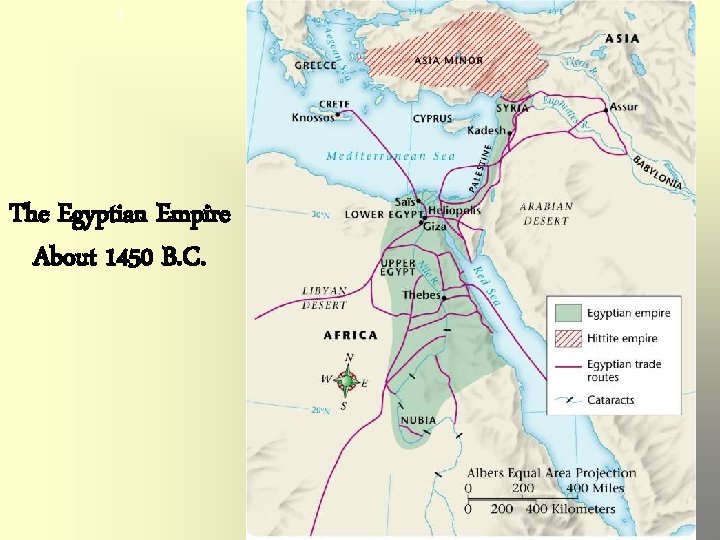
1 The Egyptian Empire Most 1450 B. C.
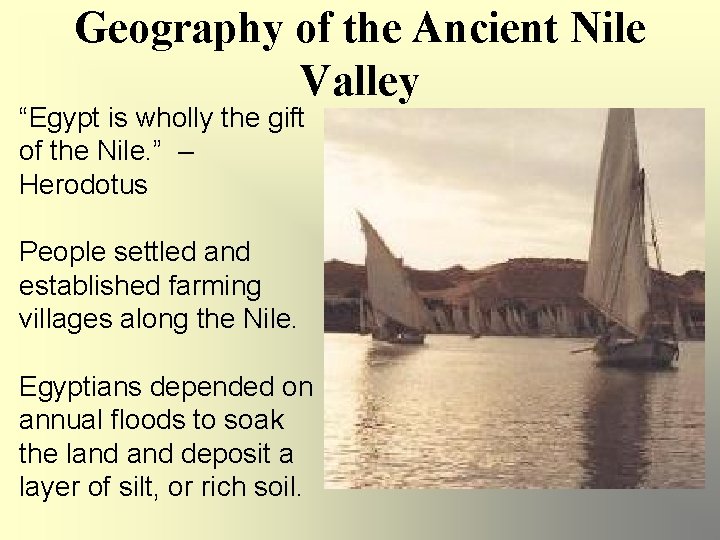
Geography of the Aboriginal Nile Valley "Arab republic of egypt is wholly the gift of the Nile. " – Herodotus People settled and established farming villages along the Nile. Egyptians depended on almanac floods to soak the land eolith a layer of silt, or rich soil.
Geography of the Ancient Nile Valley Egyptians had to cooperate to control the Nile, building dikes, reservoirs, and irrigation ditches. Rulers used the Nile to link and unite Upper and Lower Egypt. The Nile served as a trade route connecting Egypt to Africa, the Middle Due east, and the Mediterranean world.
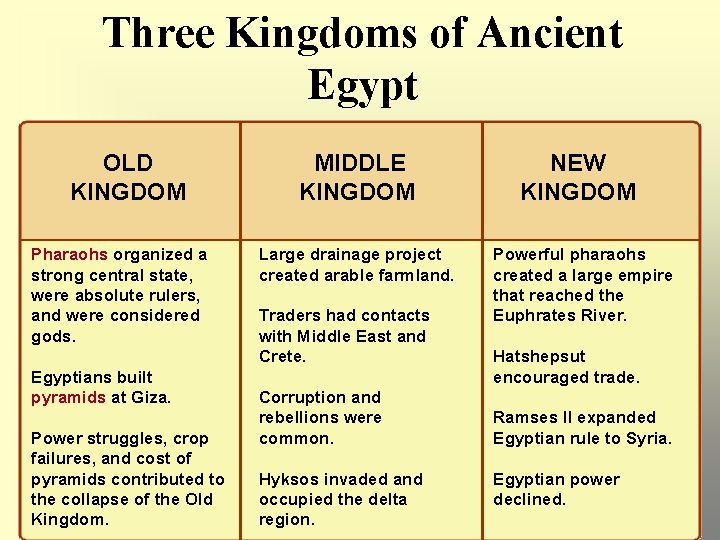
Three Kingdoms of Ancient Egypt OLD KINGDOM Pharaohs organized a potent central state, were accented rulers, and were considered gods. Egyptians built pyramids at Giza. Power struggles, crop failures, and price of pyramids contributed to the plummet of the Former Kingdom. MIDDLE KINGDOM Large drainage project created arable farmland. Traders had contacts with Middle Due east and Crete. Corruption and rebellions were common. Hyksos invaded and occupied the delta region. NEW KINGDOM Powerful pharaohs created a large empire that reached the Euphrates River. Hatshepsut encouraged trade. Ramses II expanded Egyptian rule to Syria. Egyptian power declined.
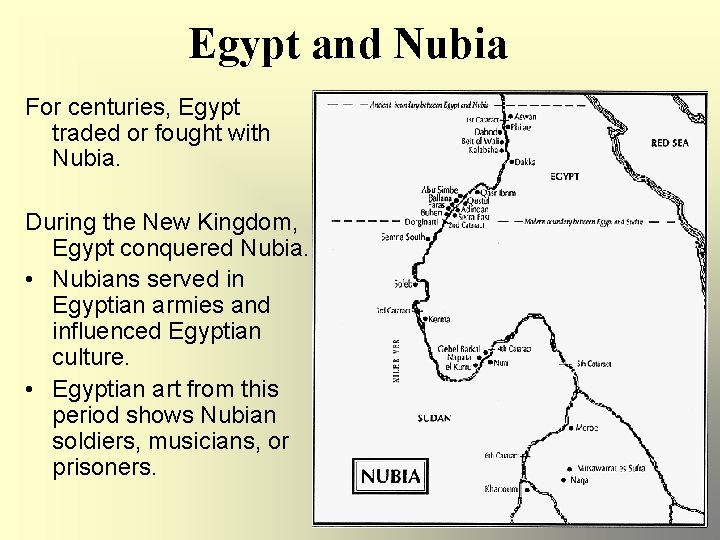
Egypt and Nubia For centuries, Egypt traded or fought with Nubia. During the New Kingdom, Arab republic of egypt conquered Nubia. • Nubians served in Egyptian armies and influenced Egyptian culture. • Egyptian art from this period shows Nubian soldiers, musicians, or prisoners.
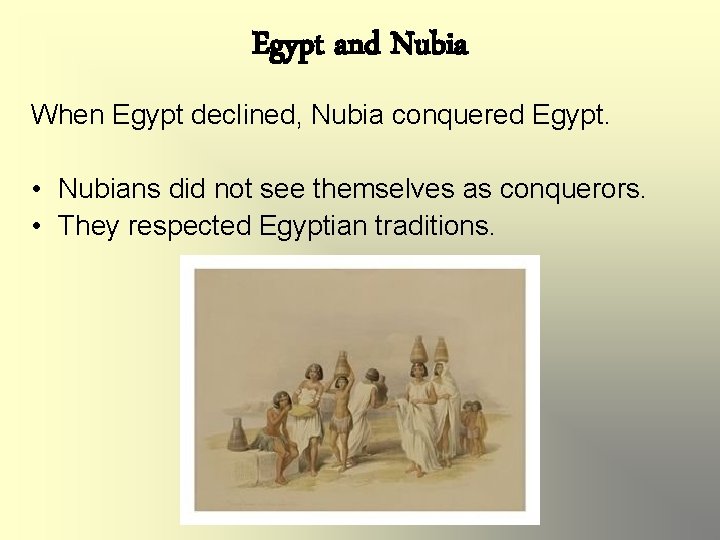
Egypt and Nubia When Egypt declined, Nubia conquered Egypt. • Nubians did not encounter themselves as conquerors. • They respected Egyptian traditions.
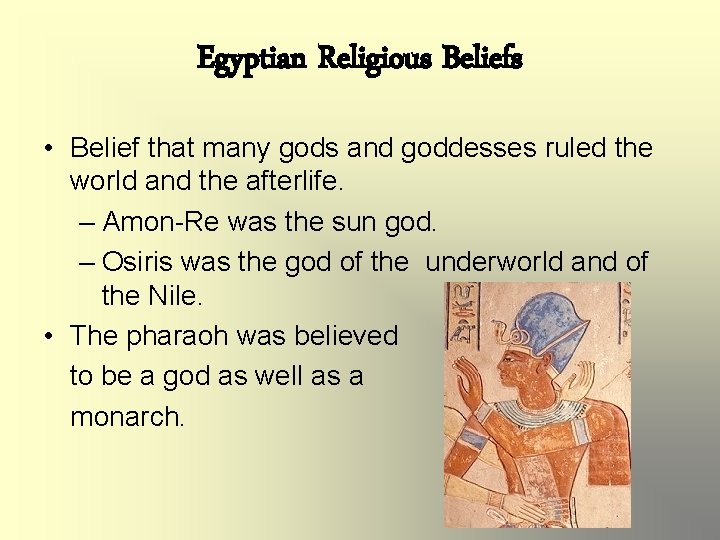
Egyptian Religious Beliefs • Belief that many gods and goddesses ruled the world and the afterlife. – Amon-Re was the dominicus god. – Osiris was the god of the underworld and of the Nile. • The pharaoh was believed to be a god likewise as a monarch.
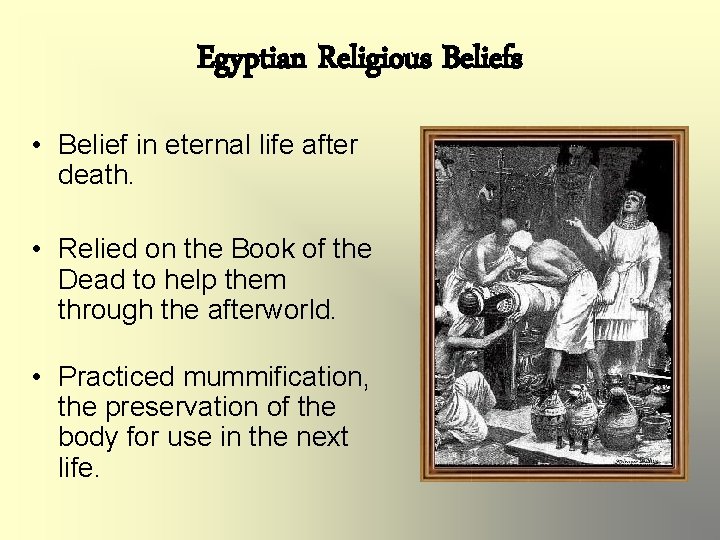
Egyptian Religious Behavior • Belief in eternal life after death. • Relied on the Book of the Dead to aid them through the afterworld. • Practiced mummification, the preservation of the trunk for use in the next life.
Ancient Egypt: A Center of Learning & Civilisation Advances in Learning Developed a form of movie writing chosen hieroglyphics. Doctors diagnosed and cured illnesses, performed surgery, and developed medicines still used today. Developed 12 -month agenda on which modern calendar is based. Astronomers mapped constellations and charted movement of the planets. Developed practical geometry. Skilled in pattern and engineering. Advances in the Arts Statues, paintings, and writings tell united states of america near aboriginal Egyptian values and attitudes. Developed painting style that remained unchanged for thousands of years. Wrote hymns and prayers to the gods, proverbs, love poems, stories of victory in battle, and folk tales. Congenital pyramids and other great buildings, such every bit temple of Ramses II.
Class System in Aboriginal Egypt PHARAOH Earthly leader; considered a god HIGH PRIESTS AND PRIESTESSES Served gods and goddesses NOBLES Fought pharaoh's wars MERCHANTS, SCRIBES, AND ARTISANS Made furniture, jewelry, and fabrics for pharaohs and nobles, and provided for other needs PEASANT FARMERS AND SLAVES Worked in the fields and served the pharaoh
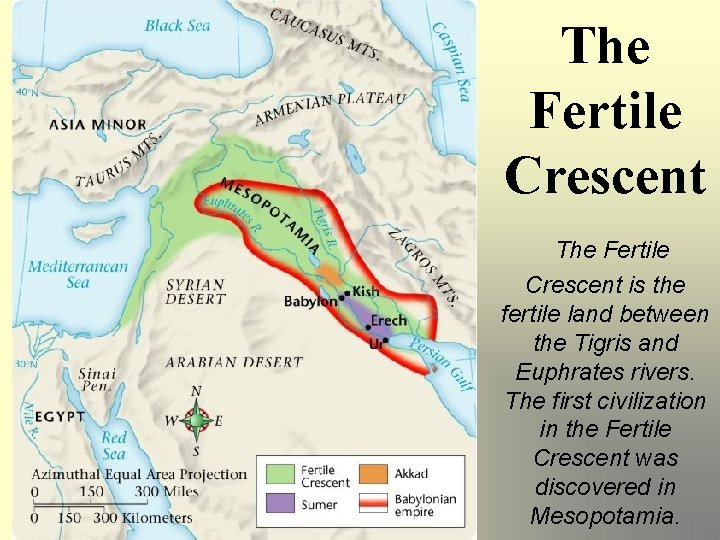
The Fertile Crescent is the fertile land between the Tigris and Euphrates rivers. The get-go civilization in the Fertile Crescent was discovered in Mesopotamia.
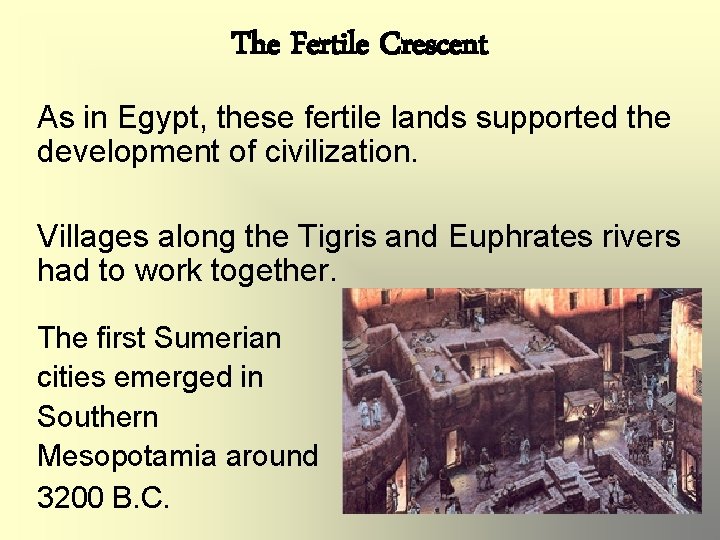
The Fertile Crescent As in Egypt, these fertile lands supported the evolution of civilisation. Villages along the Tigris and Euphrates rivers had to work together. The first Sumerian cities emerged in Southern Mesopotamia effectually 3200 B. C.
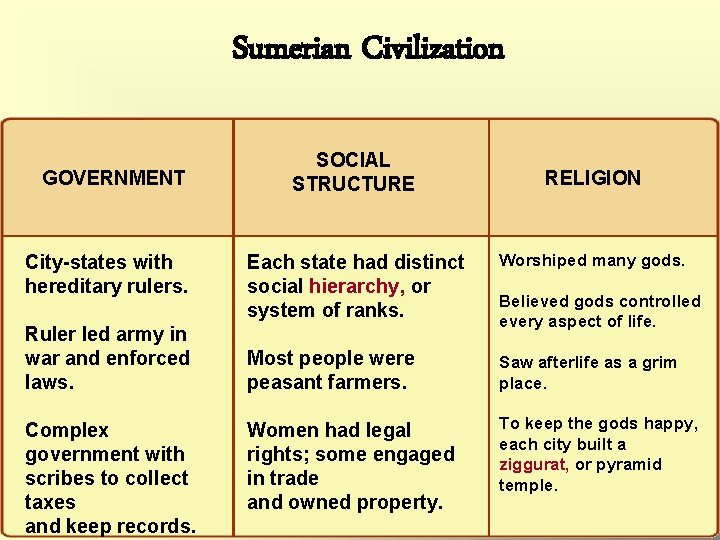
Sumerian Culture GOVERNMENT Urban center-states with hereditary rulers. Ruler led army in war and enforced laws. Complex regime with scribes to collect taxes and keep records. SOCIAL Structure RELIGION Each state had distinct social hierarchy, or system of ranks. Worshiped many gods. Near people were peasant farmers. Saw afterlife as a grim place. Women had legal rights; some engaged in trade and owned property. To keep the gods happy, each metropolis built a ziggurat, or pyramid temple. Believed gods controlled every aspect of life.
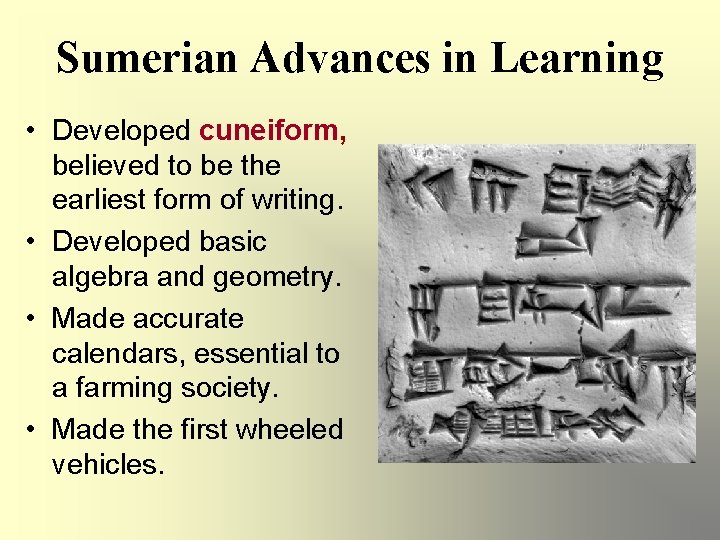
Sumerian Advances in Learning • Developed cuneiform, believed to be the earliest form of writing. • Adult basic algebra and geometry. • Fabricated authentic calendars, essential to a farming gild. • Made the first wheeled vehicles.
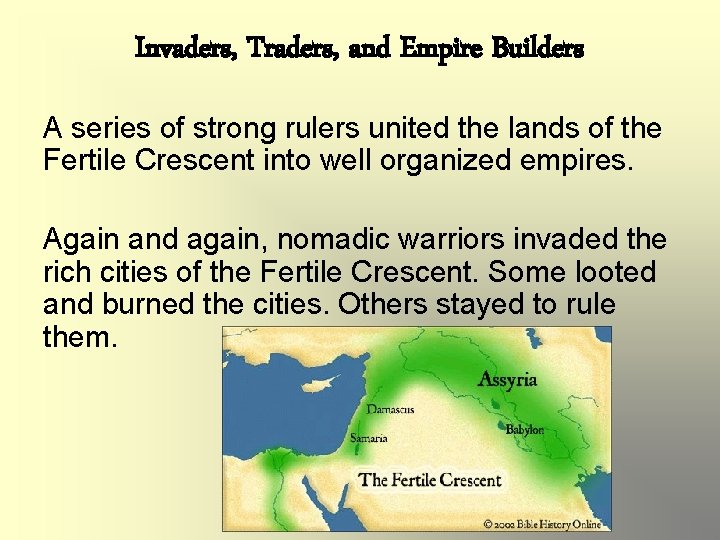
Invaders, Traders, and Empire Builders A series of potent rulers united the lands of the Fertile Crescent into well organized empires. Once more and again, nomadic warriors invaded the rich cities of the Fertile Crescent. Some looted and burned the cities. Others stayed to rule them.
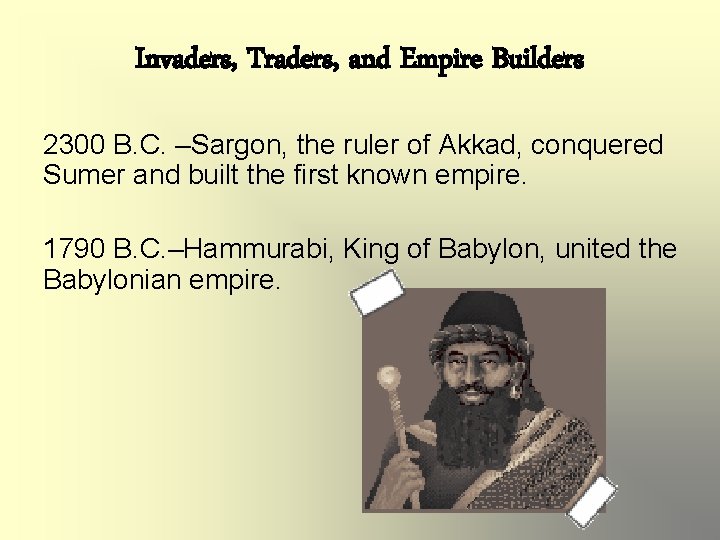
Invaders, Traders, and Empire Builders 2300 B. C. –Sargon, the ruler of Akkad, conquered Sumer and congenital the first known empire. 1790 B. C. –Hammurabi, Male monarch of Babylon, united the Babylonian empire.
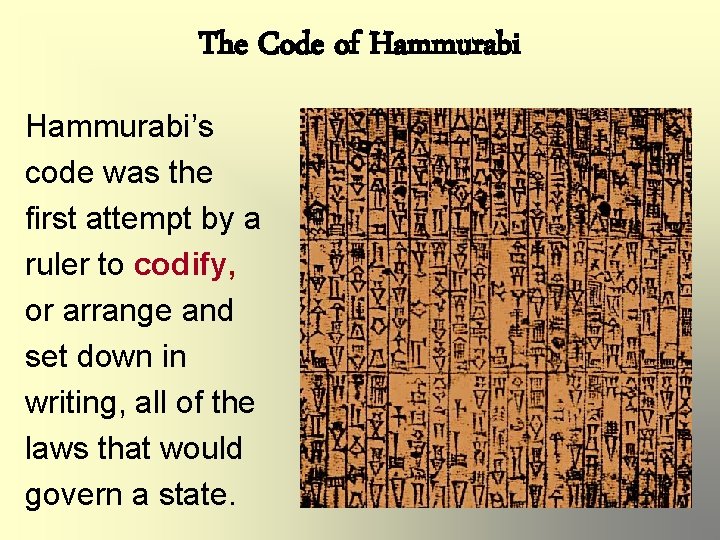
The Lawmaking of Hammurabi'due south code was the outset attempt by a ruler to codify, or arrange and set down in writing, all of the laws that would govern a state.
The Lawmaking of Hammurabi • I department codification criminal law, the branch of police force that deals with offenses against others, such every bit robbery and murder. • Some other section codified civil constabulary, the branch that deals with private rights and matters, such as business contracts, taxes, and property inheritance.
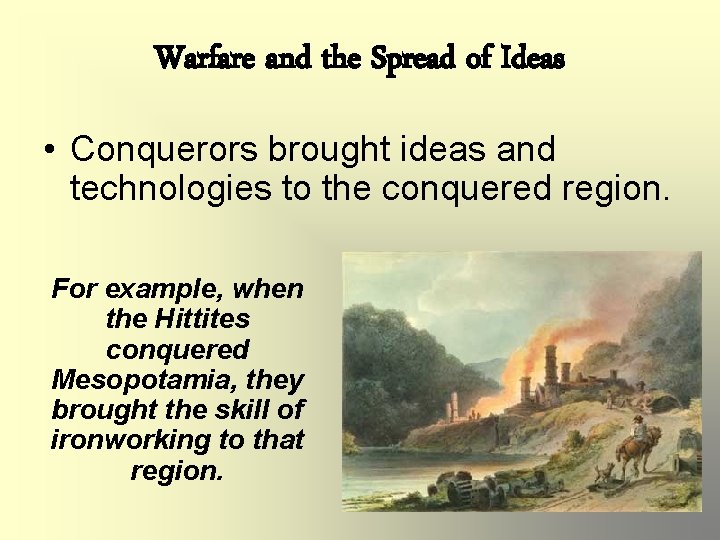
Warfare and the Spread of Ideas • Conquerors brought ideas and technologies to the conquered region. For case, when the Hittites conquered Mesopotamia, they brought the skill of ironworking to that region.
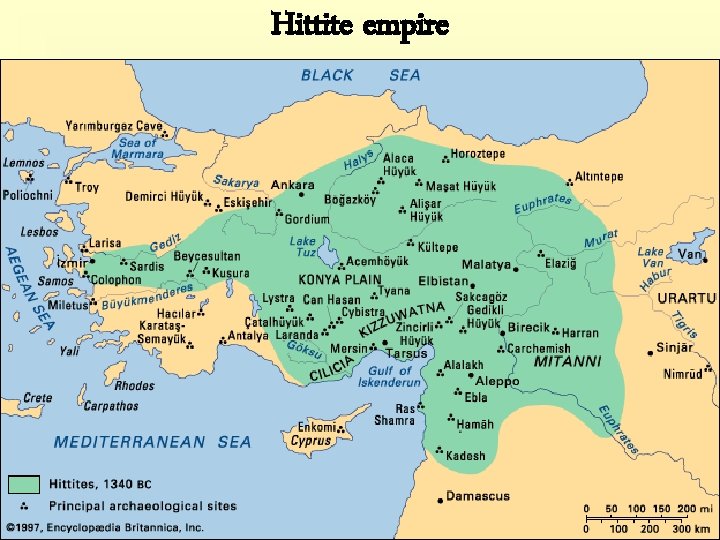
Hittite empire
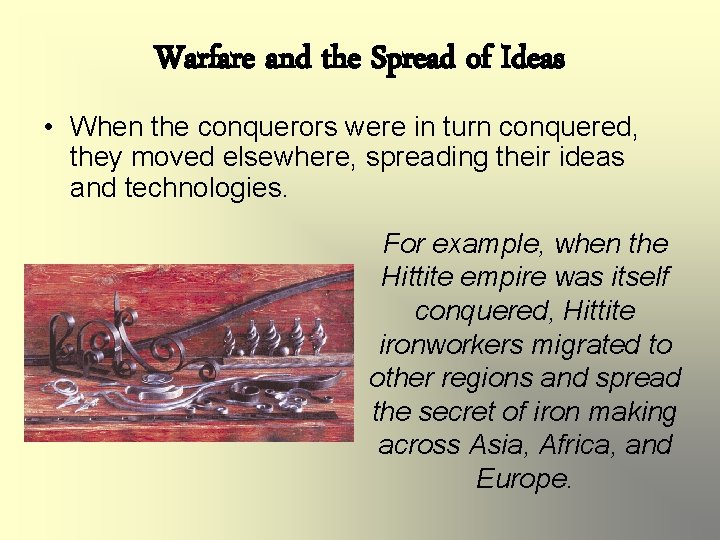
Warfare and the Spread of Ideas • When the conquerors were in plough conquered, they moved elsewhere, spreading their ideas and technologies. For case, when the Hittite empire was itself conquered, Hittite ironworkers migrated to other regions and spread the undercover of atomic number 26 making beyond Asia, Africa, and Europe.
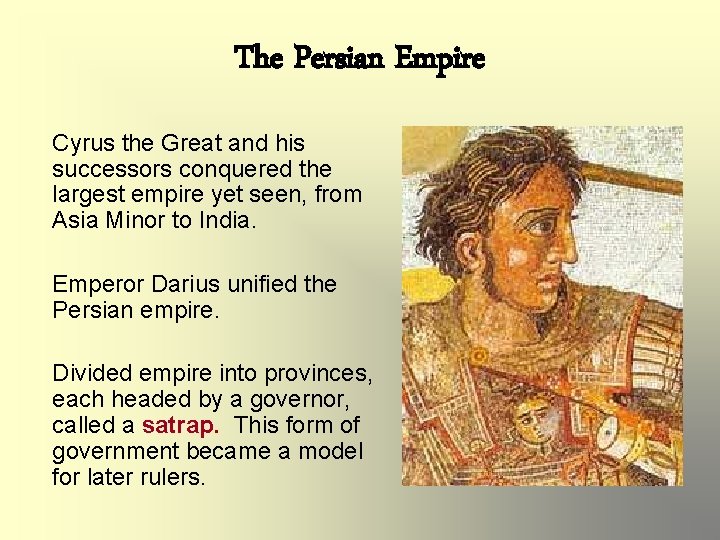
The Persian Empire Cyrus the Keen and his successors conquered the largest empire yet seen, from Asia Small to India. Emperor Darius unified the Persian empire. Divided empire into provinces, each headed by a governor, called a satrap. This form of government became a model for after rulers.
The Western farsi Empire Drew upwardly single code of laws for empire. Had hundreds of miles of roads congenital or repaired to aid communication and encourage unity. Set common ready of weights and measures to ameliorate trade. Introduced a uniform system of coinage and encouraged a money economy. Religious ideas of Zoroaster also helped to unite the empire.
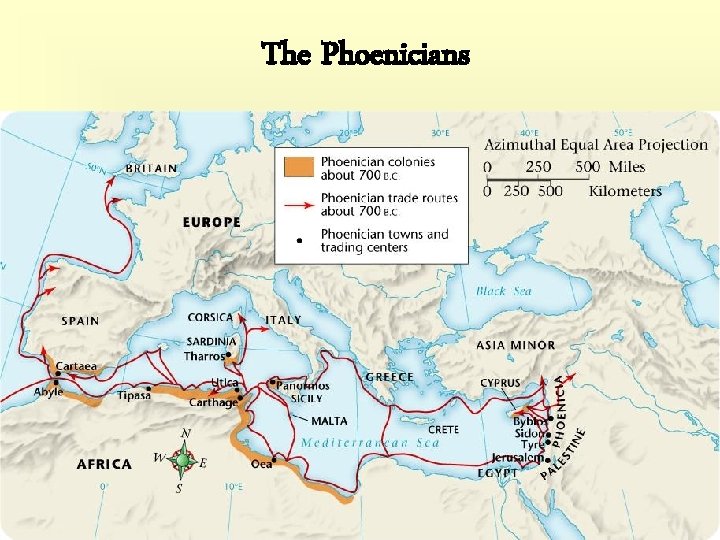
The Phoenicians
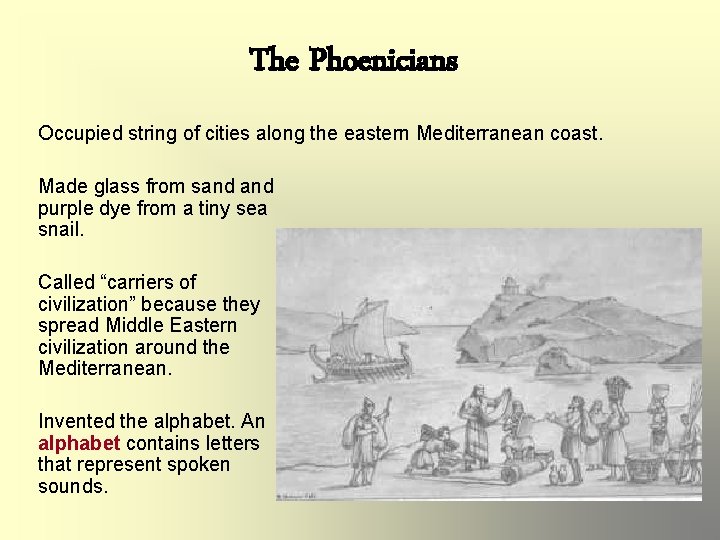
The Phoenicians Occupied string of cities along the eastern Mediterranean coast. Made glass from sand purple dye from a tiny bounding main snail. Called "carriers of civilization" because they spread Center Eastern civilization around the Mediterranean. Invented the alphabet. An alphabet contains letters that represent spoken sounds.
The Roots of Judaism • What were the main events in the early history of the Israelites? • How did the Jews view their relationship with God? • What moral and ethical ideas did the prophets teach?
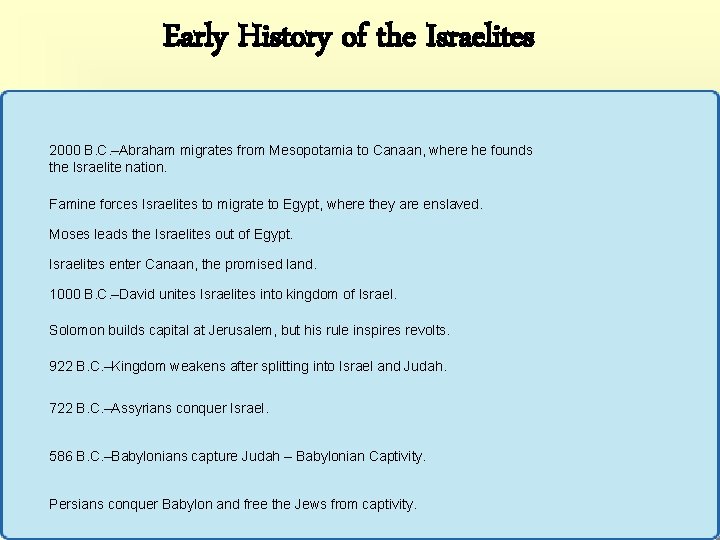
Early History of the Israelites 2000 B. C. –Abraham migrates from Mesopotamia to Canaan, where he founds the Israelite nation. Famine forces Israelites to migrate to Egypt, where they are enslaved. Moses leads the Israelites out of Egypt. Israelites enter Canaan, the promised state. 1000 B. C. –David unites Israelites into kingdom of Israel. Solomon builds capital at Jerusalem, but his rule inspires revolts. 922 B. C. –Kingdom weakens after splitting into Israel and Judah. 722 B. C. –Assyrians conquer Israel. 586 B. C. –Babylonians capture Judah – Babylonian Captivity. Persians conquer Babylon and free the Jews from captivity.
Judaism The Israelites were monotheistic, believing in one true God. At the time, most other people worshiped many gods. The Israelites believed God to exist all-knowing, allpowerful, and present everywhere. The Israelites believed that they were God's "chosen people. " They believed that God would atomic number 82 them to the "promised state. "
Teachings on Police and Morality The laws of the Torah address all aspects of life, from cleanliness and food preparation to criminal matters. Jews believe that God gave them a set of laws chosen the Ten Commandments. Jewish prophets, or spiritual leaders, preached a code of ethics, or moral standards of behavior. Examples: • The rich and powerful must protect the poor and weak. • All people are equal under God. Unlike many ancient people, the Jews believed their leaders were fully human and bound by God'due south law.
Source: https://slidetodoc.com/chapter-2-first-civilizations-africa-and-asia-3200/
0 Response to "Chapter 2 First Cicilizations Africa and Asia (3200 Bc- 500bc) Section 1 Review"
Publicar un comentario