Types of Visual Arts Types of Theatre Performances Comedy Tragedy
[photo: The Ancient Theatre at Delphi in Greece, by Leonidtsvetkov from Wikipedia]
AGITPROP
The original sense of agitprop was "agitation and propaganda on behalf of Communism", or "a authorities agency or department responsible for agitation and propaganda". The main current sense of the discussion is simply "propaganda, specially socially or politically motivated propaganda appearing in literary works, films, etc."; though the give-and-take often refers to political propaganda, information technology is not restricted to communist doctrine.
The word agitprop is first found in English sources in the mid 1930s.
From the Random House Give-and-take of the 24-hour interval website.
BOURGEOIS TRAGEDY
Bourgeois tragedy (German: Bürgerliches Trauerspiel) is a form of tragedy that developed in 18th-century Europe. Information technology is a fruit of the enlightenment and the emergence of the bourgeois class and its ethics. It is characterized by the fact that its protagonists are ordinary citizens.
Wikipedia entry
BRECHT / BRECHTIAN*
TO Be Defined
Burlesque
Developed-orientated entertainment, consisting of dancing, minimal costumes, songs and comic sketches. Popular from the 1840s in Europe and the USA.
COMEDY
An entertaining performance designed to make an audience express joy.
In Greek and Roman theatre, any play with a happy catastrophe was called a one-act, regardless of whether it was funny.
Sketch One-act - a series of short unconnected scenes, with comedic and/or stylised performances, containing jokes, which may be topical and/or satirical.
Loftier Comedy (likewise known equally pure or highbrow comedy) is a type of comedy characterized by witty dialogue, satire, biting sense of humour, or criticism of life.
Low Comedy (as well known as lowbrow humour) is more physical one-act, using slapstick or farce, with no purpose other than to cause the audition to laugh.
See also SATIRE.
DINNER THEATRE
A theatre operation that includes a meal, either at the same venue or at an next restaurant.
Although information technology was popular in the 1950s in the USA (equally Dinner Theater), at that place are withal many venues worldwide where a live performance is accompanied by a meal, usually in a tourist-focussed themed allure. Examples run daily in Las Vegas or Orlando, Florida, and include murder-mystery themes, medieval themes, or magic shows with dinner served.
DOCUMENTARY THEATRE
Documentary theatre, or theatre of fact, is theatre that wholly or in function uses pre-existing documentary fabric (such as newspapers, government reports, interviews, etc.) as source cloth for the script, ideally without altering its diction.
Where it's featured solely on the words of others, normally members of the public in a particular state of affairs, information technology's known as VERBATIM THEATRE.
DUMBSHOW
A piece of mimed action. Used in Shakespeare'southward Hamlet to summarise and comment on the main plot.
END ON
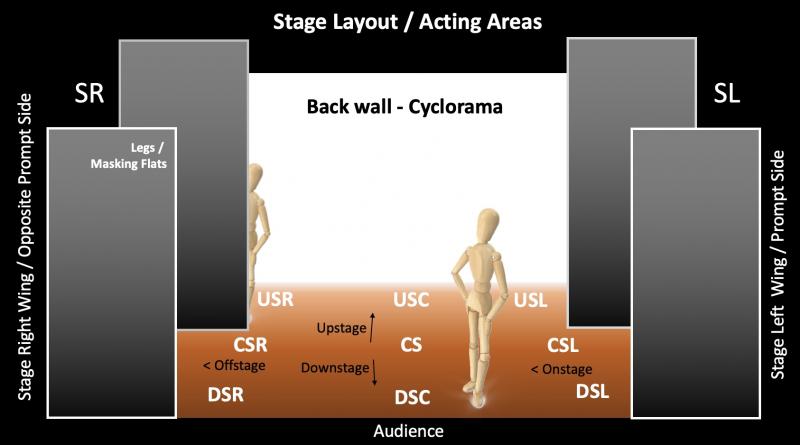 Traditional audience seating layout where the audience is looking at the stage from the same direction. This seating layout is that of a Proscenium Arch theatre.
Besides known as Proscenium Staging.
The end-on stage can exist split into 9 areas: upstage right, upstage centre, upstage left, centre stage right, heart stage, centre phase left, downstage right, downstage centre, downstage left.
Come across too THRUST, IN THE Round, TRAVERSE.
Ballsy THEATRE
Epic theatre is a theatrical motility arising in the early to mid-20th century from the theories and practice of a number of theatre practitioners who responded to the political climate of the time through the creation of a new political theatre.
Epic theatre is non meant to refer to the scale or the telescopic of the work, but rather to the form that it takes. Epic theatre emphasizes the audition's perspective and reaction to the slice through a multifariousness of techniques that deliberately crusade them to individually appoint in a different fashion The purpose of epic theatre is not to encourage an audience to suspend their atheism, but rather to force them to encounter their globe as information technology is. (from Wikipedia)
Wikipedia entry
EXPRESSIONISM
Theatre design and performance style which places greater value on emotion than realism. The trademark Expressionist furnishings were often accomplished through baloney.
FARCE
Form of comedy play originated in France, using fast-paced physical action and visual one-act more than sense of humor based on linguistic communication.
In London's West End, following the Second World War, in that location were farces at the Aldwych Theatre (the Aldwych Farces, particularly those by Ben Travers) and at the Whitehall Theatre (the Whitehall Farces).
FORUM THEATRE
Forum theatre is a type of theatre created by the influential practitioner Augusto Boal as part of what he calls his "Theatre of the Oppressed." While practicing earlier in his career, Boal would apply simultaneous dramaturgy. In this process the actors or audition members could cease a performance, often a brusque scene in which a graphic symbol was being oppressed in some way. The audience would advise different deportment for the actors to carry out on-stage in an effort to change the effect of what they were seeing. This was an try to undo the traditional actor/audience divide and to bring audition members into the performance, to accept an input into the dramatic activity they were watching.
FUTURISM
An artistic and social motion that started in Italy in the early on 20th century. In art, information technology celebrated technologies of the time - air travel, machinery, industrialisation. Futurist ideas helped to class Fine art Deco, Vorticism, Constructivism, Surrealism, Dada, and much afterwards Neo-Futurism. In theatre, it fought against classical forms of theatre and celebrated the youthful, spontaneous, and satirical, encouraging vaudeville and music hall forms.
Wikipedia entry
One thousand GUIGNOL
Shock theatre form originally from Le Thousand Guignol theatre in Montmartre, Paris (opened in 1897). Specialised in portraying the macabre & gruesome to the delight and horror of the audience.
IMMERSIVE THEATRE
1) A piece of linear performance where the venue has been adapted / altered to make it part of the narrative of the story. Clandestine Cinema events are immersive in this sense.
2) A piece of non-linear performance where a not-theatre venue has been completely transformed into a highly detailed earth within which the audience is free to roam and see various parts of the story performed in appropriate locations. The Great britain company Punchdrunk created the concept of audience members wearing masks which permit them to wander around the space anonymously.
Punchdrunk Theatre
IN THE ROUND
Theatre in the Round is a form of audience seating layout where the interim area is surrounded on all sides past seating. In that location are often a number of entrances through the seating. Special consideration needs to be given to onstage furniture and scenery every bit audience sightlines can easily be blocked.
Stage managers and directors ofttimes utilise the idea of a clock face to depict actor positions on stage (e.grand. the aisle nearest the technical betoken is described every bit the 12 O'clock position, with other aisles described equally three, half dozen and 9 O'clock.)
See also ARENA, THRUST, END ON, TRAVERSE.
INSTALLATION
1) An electrical system in a particular building (east.m. "the stage lighting installation was tested last twelvemonth")
2) A piece of art designed to transform a item room or building into something other than a room in an fine art gallery. Installations ofttimes use circuitous acoustic equipment and can exist intensely immersive experiences. (east.g. "In the studio space this week nosotros have an installation by John Doe entitled 'Space'")
LEGITIMATE THEATRE Legitimate theater now refers to theatres that produce 'serious', high-quality professional piece of work rather than multifariousness or burlesque.
The term was originally derived from the Britain Licencing Deed of 1737, which sought to censor and control what theatrical performances were able to say nigh the government.
In 1660, later the Restoration of Charles Ii, the previous ban on public entertainments was lifted, and letters patent were granted to Thomas Killigrew and William Davenant to form two theatre companies to perform 'serious drama'.
Other theatres were non permitted to perform such serious work, but could put on comedy, pantomime or melodrama.
All performances were licenced by the Examiner of Plays.
The 1843 Theatres Human activity permitted all theatres to perform 'serious' drama, simply censorship and licencing were in place until 1968, when a new Theatres Act was created.
MELODRAMA
A Melodrama is a dramatic work that exaggerates plot and/or characters in society to appeal to the emotions. It is unremarkably based around having the same character traits, (for instance, a hero, who is fearless and who the audition is rooting for, the heroine, who is usually in peril of some kind, which the hero rescues her from; the villain (usually likes the heroine too) and villain's sidekick (typically gets in the way of or annoys the villain).
The term is as well used in scholarly and historical musical contexts to refer to dramas of the 18th and 19th centuries in which orchestral music or vocal was used to back-trail the action.
METATHEATRE
This term, coined past Lionel Abel, has entered into common critical usage; still, at that place is still much dubiety over its proper definition and what dramatic techniques might be included in its scope. Abel described metatheatre every bit reflecting comedy and tragedy, at the aforementioned time, where the audition tin can express mirth at the protagonist while feeling empathetic simultaneously.
Wikipedia entry
MINIMALISM
Artistic movement starting in the 1960s which aspired to simple form and design. A minimalist theatrical stage design might involve only the essential compoents of the scene (e.g. a single chair and a suspended window frame, and no other set or furniture).
The ruling mantra is 'Less is More than'. Information technology is often best to take away things when the stage picture is non right, rather than calculation more - this applies to stage lighting as well as breathtaking pattern.
MIRACLE PLAY
Run into MYSTERY PLAY.
MORALITY PLAY
An allegorical performance in whcih the protagonist is met by personifications of diverse moral attributes who try to prompt him to cull a godly life over 1 of evil. Popular in Europe during the 15th and 16th centuries.
Wikipedia entry
MUSIC HALL
A type of British theatrical amusement popular between 1850 and 1960. Information technology involved a mixture of popular song, comedy, speciality acts and multifariousness entertainment. The term is derived from a type of theatre or venue in which such entertainment took identify. British music hall was similar to American vaudeville, featuring rousing songs and comic acts, while in the United Kingdom the term vaudeville referred to more working-form types of amusement that would have been termed burlesque in America.
MYSTERY PLAY
Also known every bit a Miracle Play. Traditional since medieval times, the Mystery Play is a re-enactment of bliblical scenes, usually performed outdoors in a small town or village, by the community.
A Passion Play is a cycle of plays that portray the Easter story, specifically. I of the almost famous is the Oberammergau Passion Play, performed in the German town in years ending in a aught.
What is a Miracle Play
Oberammergau Passion Play
NATURALISM Heightened Naturalism involves exaggerating the natural elements of the scene for dramatic (or comedic) purposes.
1) Lighting Design: A naturalistic arroyo to lighting design requires lanterns to exist placed in ways that indistinguishable where the light would come from in nature. For example, a sunny 24-hour interval outdoor scene would be lit primarily from higher up the acting expanse, with fill up lighting in from the sides as if from the cloud. A dark room would exist lit past moonlight through a window, and the low-cal level would increase when a door is opened from a lit corridor or when a low-cal fitting is turned on.
ii) Performance: A naturalistic functioning (following the techniques of Stanislavski) requires that the player completely understands and inhabits every attribute of the characters' life, likewise every bit the motivation and lines that are to be spoken.
3) Scenic Design: The set designer aims to reproduce reality as closely as possible.
One PERSON SHOW
An entire operation for a unmarried performer. Also known as One-Homo Show or One-Woman Show.
Relies on a stiff characterisation and a confident performer. The performer is somes also the writer, but not necessarily.
"Fleabag" is written and performed by Phoebe Waller-Bridge and was very successful at the Edinburgh Fringe and in London.
"Old Herbaceous" is a i-homo testify performed in an on-stage recreation of a gardeners' potting shed.
There are thousands of other examples.
Encounter as well MONOLOGUE and SOLILOQUY.
Fleabag
Old Herbaceous
OPERA
i) European terminology pregnant Opera Business firm - lavishly busy proscenium theatre with orchestra pit. See TOSCA.
2) Musical grade. Highly dramatic and stylised form where the text is completely sung.
Meet also OPERETTA, OPERA HOUSE.
OPERETTA
A short (often humourous) opera with songs (sometimes in an operatic style) and some spoken dialogue.
The most well-known are by Gilbert & Sullivan, some of which were first performed at the Savoy Theatre in London.
PANTOMIME
1) A pantomime (frequently shortened to Panto) is a musical-comedy family-orientated theatrical production traditionally performed in United Kingdom, Australia, New Zealand, Canada, Zimbabwe, Jamaica, South Africa, India, Ireland, Gibraltar, and Malta, at Christmas-fourth dimension. The panto often features slapstick or messy comedy routines, children dancing, recent songs, spectacular sets and colourful costumes, and is oft themed around a fairy story or nursery rhymes.
Popular pantos include Cinderella, Aladdin, Jack and the Beanstalk, Mother Goose, Sleeping Beauty, Snow White and the Seven Dwarfs, Dick Whittington and His Cat, Puss in Boots etc.
At that place are a number of traditions with panto, including that the baddie / villain must enter phase left, and the goodie / fairy godmother must enter stage right. The colour dark-green is often used for the baddie, and pink for the goodie.
ii) Pantomime is an ancient blazon of performance with no spoken words, oft now shortened to 'Mime'.
Puss in Boots, Dec 2013, Hackney Empire - Sound Slideshow (The Guardian)
Operation ART
An interdisciplinary operation presented to an audience. The performance may be either scripted or unscripted, random or carefully orchestrated; spontaneous or otherwise carefully planned with or without audition participation. The functioning can be live or via media; the performer tin can be present or absent-minded. It can be whatever situation that involves 4 basic elements: time, infinite, the performer's body, or presence in a medium, and a relationship between performer and audience. Performance fine art can happen anywhere, in any venue or setting and for whatsoever length of fourth dimension. The actions of an individual or a group at a item place and in a item fourth dimension constitute the work.
Concrete THEATRE
Physical theatre is a genre of functioning which makes apply of the torso (every bit opposed to the spoken word) as the main means of performance and communication with an audition. In using the torso, the performer or actor volition concentrate on:
The utilise of trunk shape and position
Facial expressions
Rhythmical movement, pace and the energy of the body
Gesture
Posture
Gait
Physical theatre can be distinquished from trip the light fantastic toe in that it tends to focus more on narrative, grapheme and action. However, the boundaries betwixt the two are rather blurred.
There are various styles and genre of physical theatre. These include:
Concrete comedy - where the body is the primary means of comic cosmos
Mime
Stomp- where the trunk, with external objects, is used for its percussive potential
Some forms of puppetry
Circus
The virtually famous institution devoted to physical theatre is the Lecoq school in Paris. Students here follow the method of Jacques Lecoq, which developed out of his experience of mask work, commedia dell'Arte and his involvement in the physicality of operation.
Definition from Wikipedia - click for more
Lecoq Schoolhouse
PROMENADE
Form of staging where the audition moves around the performance space and sees the play at a variety of different locations. See also IMMERSIVE THEATRE.
REVUE
A blazon of functioning consisting of lighthearted songs and comic sketches - a variety show.
SINAKULO
A retelling of the story of Jesus Christ, performed each twelvemonth during Holy Week in lowland Philippines. Performed outdoors by and for the community in villages that discover this folk drama tradition.
See also MYSTERY PLAYS.
SITCOM
Curt for State of affairs Comedy - a Radio or Boob tube testify featuring a regular cast of characters who, each episode, discover themselves in a dissimilar situation, with comic outcomes. There are often storylines or character arcs which continue alongside the weekly situations. Examples are Friends, The Office, Will & Grace, Blackadder, Futurama, Fawlty Towers etc.
SITE-SPECIFIC THEATRE
A piece of performance which has been designed to work only in a particular non-theatre space. The space may have been adapted to fit into the themes or manner of the production. A site-sensitive (or infinite-sensitive) piece, on the other hand, will not adapt the infinite, merely piece of work with it's style and history to create a piece of functioning. See also PROMENADE, IMMERSIVE THEATRE, INSTALLATION.
SKIT
A short (ordinarily) comedic sketch, often satirical or a parody.
SONGSHEET
Traditional ending to a British Pantomime performance, usually involving the Dame character encouraging the audience to sing along with a traditional (and/or silly) song that conveniently allows the stage management team to gear up the WALKDOWN, a usually spectacular finale to the performance. The lyrics of the song are flown in, in front end of the frontcloth. This sequence may also involve announcing whatsoever special visitors or audience birthdays, and possibly inviting a couple of children to the stage to take part in the song.
SPECTACLE
A theatrical operation using large scale scenery and effects to wow the audience. Popularised in Victorian times, they featured water tanks, live animals, moving stages and aerial effects.
STASIMON
(Greek Tragedy) A stationary song, composed of strophes and antistrophes and performed past the chorus in the orchestra, which ends each Episode.
Wikipedia entry
THEATRE OF CRUELTY
Theatre of Cruelty is a class of theatre originally developed past avant-garde French playwright, essayist, and theorist Henry Becque.
Antonin Artaud, some 50 years after, is also seen as a main correspondent to the genre, notably with The Theatre and its Double. Originally a fellow member of the surrealist movement, Artaud eventually began to develop his own theatrical theories. The Theatre of Cruelty tin can be seen every bit a intermission from traditional Western theatre and a means past which artists assail the senses of the audience, and allow them to feel the unexpressed emotions of the subconscious. While Artaud was but able to produce i play in his lifetime that reflected the tenets of the Theatre of Cruelty, the works of many theatre artists reflect his theories. These artists include Jean Genet, Jerzy Grotowski, and Peter Brook. (from Wikipedia)
Wikipedia entry
THEATRE OF THE ABSURD
The Theatre of the Absurd is a postal service–World War II designation for item plays of absurdist fiction written by a number of primarily European playwrights in the late 1950s. Information technology is besides a term for the way of theatre the plays stand for. The plays focus largely on ideas of existentialism and limited what happens when human being lacks meaning or purpose and communication breaks down. The structure of the plays is typically a circular shape, with the finishing indicate the aforementioned equally the starting point. Logical construction and argument give way to irrational and illogical speech communication and to the ultimate conclusion—silence.
Examples of absurdist plays include Beckett's Waiting for Godot, Jean Genet's The Maids and Stoppard's Rosencrantz and Guildenstern Are Dead.
Wikipedia entry
TRAGEDY
Tragedy (from the Greek tragos which means 'goat' and oide which means 'song') is a class of drama based on human suffering that invokes in its audience an accompanying catharsis or pleasure in the viewing. While many cultures accept developed forms that provoke this paradoxical response, the term tragedy often refers to a specific tradition of drama that has played a unique and important role historically in the self-definition of Western civilization.
TRAGI-COMEDY / TRAGICOMEDY
Tragicomedy is a literary genre that blends aspects of both tragic and comic forms. Most often seen in dramatic literature, the term tin variously describe either a tragic play which contains enough comic elements to lighten the overall mood or a serious play with a happy ending.
TRAVERSE
Form of staging where the audience is on either side of the interim area.
Also known equally Aisle or AVENUE staging.
See also IN THE ROUND, END ON, THRUST.
USITT
Usa Institute of Theatre Engineering.
Founded in 1960. Publisher of Theatre Design and Applied science and Sightlines journals, which are available online (encounter Publications in the Theatrecrafts.com Archive section).
USITT Website
VAUDEVILLE
A type of light-hearted entertainment popular chiefly in the US in the early 20th century, featuring a mixture of speciality acts such equally burlesque comedy and vocal and trip the light fantastic toe.
VECCHIO
Category of stock character from Commedia dell'Arte - consists of the 'old man' characters: Il Dottore (the Doctor), Pantalone, Il Capitano (the Captain). Vecchio is the Italian give-and-take for 'sometime'.
ZARZUELA
A Castilian lyric-dramatic genre that alternates between spoken and sung scenes, the latter incorporating operatic and popular song, equally well equally dance.
A list of words relating to different forms of theatre, including play genres, creative styles etc.Includes links to more in-depth information near Immersive Theatre, Pantomime, Performance Art and Spectacle.
Words include: Agitprop, Brechtian, Caricatural,Dinner Theatre, Documentary Theatre, End On, Epic Theatre, Expressionism, Farce, Forum Theatre, Futurism, Grand Guignol, In the Round, Installation, Legitimate Theatre, Melodrama, Metatheatre, Mime, Phenomenon Play, Music Hall, Mystery Play, Naturlaism, Opera, Pantomime, Performance Art, Physical Theatre, Promenade, Revue, Sinakulo, Site-Specific Theatre, Songsheet, Spectacle etc.,
Keywords; Types of plays, types play genres, genres plays, types play genres, forms of theatre, thetrical forms, different theatre forms, unlike theatrical forms, different forms of theatres
Source: https://www.theatrecrafts.com/pages/home/topics/forms-of-theatre/
0 Response to "Types of Visual Arts Types of Theatre Performances Comedy Tragedy"
Publicar un comentario